Why Matching Your Resume to the Job Description Matters (And How to Do It Fast)
Why Matching Your Resume to the Job Description Matters (And How to Do It Fast)
You've spent hours perfecting your resume. Your experience is impressive. Your skills are relevant. You hit "apply" with confidence.
Then... silence.
No interview calls. No emails. Nothing.
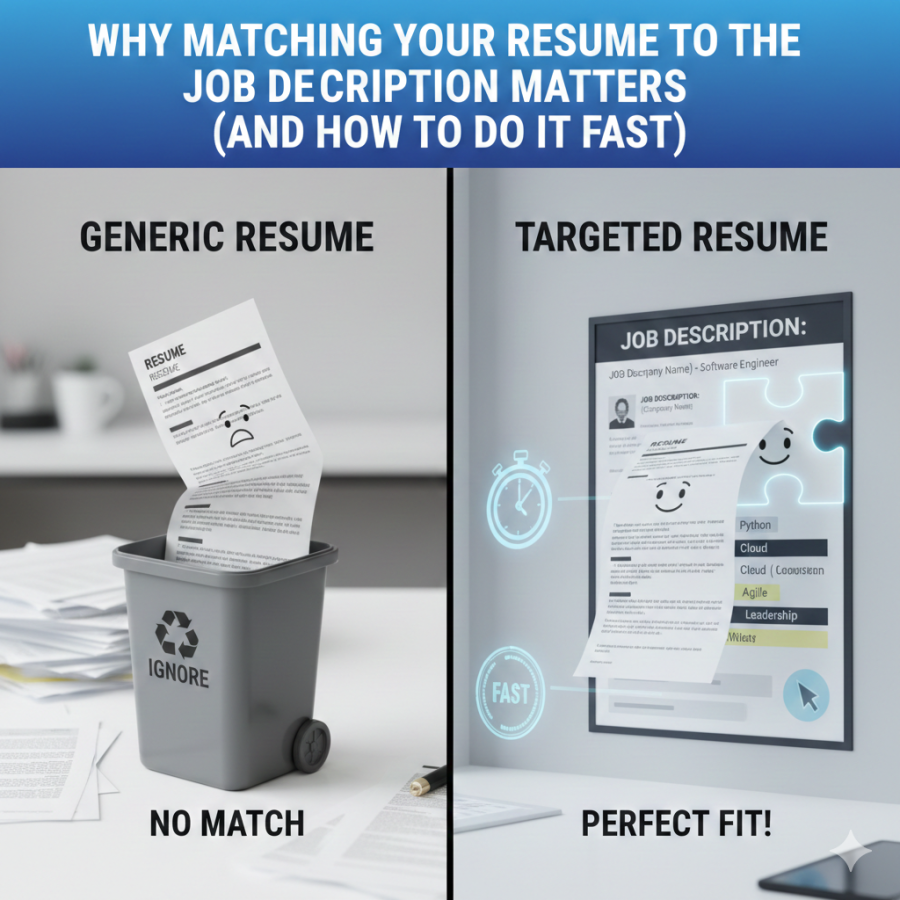
Here's the uncomfortable truth: Your qualifications might be perfect, but if your resume doesn't align with the job description, you'll never get the chance to prove it.
This comprehensive guide explains why resume-job alignment is the most critical factor in getting interviews—and how JobQlick's tools help you achieve it in minutes, not hours.
The ATS Gatekeeper: Why Alignment Matters
Before any human sees your resume, it must pass through an Applicant Tracking System (ATS). This software ranks candidates based on how well their resumes match the job description.
The Statistics Are Brutal:
● 75% of resumes are rejected by ATS before reaching human recruiters
● Companies receive 250+ applications per job opening on average
● Only 2% of applicants get interview calls
● 88% of qualified candidates are filtered out due to poor keyword matching
This happens because most job seekers don't understand how ATS works—or they assume their qualifications will speak for themselves.
They won't. Not if ATS never shows your resume to anyone.
For both fresher jobs in India and senior positions, ATS optimization is non-negotiable in 2025.
How ATS Actually Ranks Your Resume
Understanding the mechanics helps you beat the system:
Step 1: Keyword Extraction
ATS scans the job description and identifies critical keywords—skills, qualifications, job titles, software names, certifications.
Step 2: Resume Parsing
Your resume is parsed (converted from formatted document to plain text data). Fancy formatting often breaks this process.
Step 3: Keyword Matching
ATS compares keywords from the job description against words in your resume, calculating a match percentage.
Step 4: Ranking
All applicants are ranked by match score. Top 10-20% move forward to human review.
Step 5: Human Screening
Only now does a recruiter see your resume—and they spend 6-8 seconds deciding if you're worth an interview.
If you fail Step 3, Steps 4 and 5 never happen.
The Resume-Job Description Gap
Most resumes fail because of three alignment gaps:
Gap 1: Keyword Mismatch
The job description says "proficient in React.js"—your resume says "experienced with front-end frameworks."
Both describe the same skill, but ATS doesn't recognize the match.
Gap 2: Missing Hard Skills
The job requires specific tools, software, or technologies not mentioned anywhere in your resume.
Gap 3: Misaligned Experience
Your experience is relevant, but it's described using different terminology than the job posting.
Example:
Job Description: "Seeking data analyst with SQL expertise and Tableau dashboard experience"
Your Resume: "Analyzed business data using database queries and created visual reports"
You have the skills—but ATS doesn't see the match because keywords don't align.
Why Manual Alignment Takes Too Long
Theoretically, you could manually compare every resume to every job description. But:
● It's time-consuming (20-30 minutes per application)
● It's tedious (reading JDs repeatedly is exhausting)
● It's inconsistent (you'll miss keywords)
● It doesn't scale (applying to 50 jobs takes 25 hours)
This is why job search platforms offering automated matching tools are game-changers.
How JobQlick's Resume to Job Match Tool Works
JobQlick's Resume to Job Match tool automates alignment analysis in seconds.
The Process:
Upload Your Resume
Drag and drop your resume (PDF or DOCX format).
Paste Job Description
Copy the complete job description from any job posting site in India and paste it into the tool.
AI Analysis
Advanced AI analyzes:
● Keyword overlap between resume and job description
● Missing critical skills or qualifications
● Strength of alignment in each resume section
● ATS compatibility issues
Get Your Match Score
Receive a percentage score (0-100%) indicating alignment strength.
Receive Detailed Recommendations
The tool identifies:
● Missing keywords that should be added
● Weak sections that need strengthening
● Specific phrases from the JD to incorporate
● Skills gaps to address
Optimize and Recheck
Make recommended changes, upload updated resume, and verify your match score improved.
Target: 75%+ match score for competitive applications.
Real-World Alignment Example
Let's see the tool in action:
Original Resume Section: "Managed digital marketing campaigns across multiple channels including social media and email"
Job Description Excerpt: "Seeking digital marketing specialist with experience in Google Ads, Facebook Ads Manager, email marketing automation (Mailchimp), and Google Analytics. Must demonstrate ROI improvement through campaign optimization."
Resume to Job Match Analysis:
● Match Score: 42%
● Missing Keywords: Google Ads, Facebook Ads Manager, Mailchimp, Google Analytics, ROI, campaign optimization
● Recommendation: Add specific platforms and quantify results
Optimized Resume Section: "Managed multi-channel digital marketing campaigns using Google Ads and Facebook Ads Manager, achieving 35% ROI improvement through continuous campaign optimization. Executed email marketing automation via Mailchimp with 28% average open rate. Analyzed performance using Google Analytics to inform data-driven strategy adjustments."
New Match Score: 86%
This optimization took 3 minutes using JobQlick's tool vs. 30+ minutes of manual analysis.
The Fast Alignment Process: Step by Step
Here's how to achieve resume-job alignment quickly:
Step 1: Create Master Resume (One Time)
Build comprehensive resume using JobQlick Resume Builder with all your experience, skills, and achievements.
Step 2: Find Target Job
Locate job posting on any job hiring platform or company website.
Step 3: Run Match Analysis (2 minutes)
● Copy job description
● Visit Resume to Job Match tool
● Upload resume and paste JD
● Review analysis
Step 4: Make Strategic Adjustments (5-10 minutes)
Based on recommendations:
● Add missing keywords naturally into relevant sections
● Highlight experiences that match JD priorities
● Reorder bullet points to emphasize relevant skills
● Adjust professional summary to mirror job requirements
Step 5: Verify Improvement (1 minute)
Re-run match analysis to confirm score increased.
Step 6: Apply with Confidence
Submit optimized resume knowing it will perform well in ATS.
Total Time: 8-13 minutes per application
Compare this to hours of manual optimization—or worse, sending generic resumes that get auto-rejected.
Advanced Alignment Strategies
Once you understand the basics, level up with these strategies:
Strategy 1: Multi-Job Pattern Analysis
Run your resume against 10 similar job descriptions. Identify keywords that appear in most postings—these are critical for your industry/role.
Strategy 2: Tiered Keyword Integration
● Tier 1 (must-have): Hard skills, certifications, specific tools
● Tier 2 (important): Soft skills, industry terminology
● Tier 3 (nice-to-have): Peripheral skills or preferences
Prioritize Tier 1 keywords in your optimization.
Strategy 3: Context-Specific Keywords
Don't just list keywords—use them in context:
❌ Skills: "Python, Data Analysis, Machine Learning"
✅ "Developed machine learning models using Python and scikit-learn to analyze customer behavior data, improving prediction accuracy by 23%"
The second version provides context while including keywords naturally.
Strategy 4: Section-Specific Optimization
Different resume sections serve different purposes:
● Professional Summary: High-level keyword overview
● Work Experience: Keywords + quantified achievements
● Skills Section: Comprehensive keyword list
● Certifications: Exact certification names from JD
Common Alignment Mistakes
Mistake 1: Keyword Stuffing
❌ "Experienced with Python, Java, C++, JavaScript, Ruby, PHP, Swift, Kotlin, Go, Rust..."
ATS is smart enough to detect unnatural keyword loading. Recruiters definitely are.
Mistake 2: Ignoring Soft Skills
While technical skills dominate, don't ignore soft skills mentioned in JD like "leadership," "collaboration," "communication," "problem-solving."
Mistake 3: Exact Copy-Paste
Don't copy sentences directly from job descriptions. Use keywords in your own authentic descriptions.
Mistake 4: Over-Optimization
Aim for 75-85% match. Trying to hit 100% usually results in awkward, unnatural language.
Mistake 5: One-and-Done
Job descriptions evolve. If applying to updated postings, re-run your match analysis.
Alignment for Different Career Stages
For Fresher Jobs in India:
You have less experience to draw from, so alignment focuses on:
● Academic projects using required technologies
● Relevant coursework
● Certifications matching job requirements
● Internships or volunteer work
Even without professional experience, you can achieve 70%+ match scores by strategically highlighting relevant academic and project experience.
For Mid-Career Professionals:
You have more content, so be selective:
● Emphasize experiences most relevant to target role
● De-emphasize or condense less relevant positions
● Update skill terminology to match current industry standards
For Senior Leaders:
Focus on strategic alignment:
● Leadership and management keywords
● Industry-specific expertise
● Strategic outcomes and business impact
● Team size, budgets, and scope of responsibility
Why Speed Matters in Job Search
The job market moves fast. Average time-to-fill for competitive roles: 1-2 weeks.
If you spend 2 hours optimizing each application, you can apply to 2-3 jobs daily.
If you spend 10 minutes using JobQlick's tools, you can apply to 10-15 jobs daily—5x more volume with better quality.
Volume + Quality = Success
More aligned applications = more interviews = better job offers.
Measuring Your Success
Track these metrics to validate your alignment strategy:
Match Score Progression
Document before/after scores. Target consistent improvement.
Application-to-Interview Ratio
What percentage of applications result in interviews? Industry average: 2-10%. With optimization: 10-20%.
Interview Quality
Are interviewers asking about things specifically mentioned in your resume? Good sign your alignment worked.
Time Saved
Track optimization time per application. Goal: under 15 minutes.
The JobQlick Advantage
Unlike basic job search sites in India, JobQlick provides an integrated ecosystem:
End-to-End Solution:
● Build resume → Match to jobs → Apply
AI-Powered Intelligence:
Machine learning trained on thousands of successful applications
Real-Time Feedback:
Instant match scores and recommendations
Unlimited Usage:
Optimize for unlimited jobs at no cost
Indian Market Expertise:
Understands hiring patterns in Indian companies across sectors
Whether searching on JobQlick or other job agencies in India, our tools give you a competitive edge.
Your Action Plan
This Week:
- Create master resume using Resume Builder
- Identify 5 target jobs
- Run match analysis on all 5
- Optimize and apply to top 3
- Track results
This Month:
- Apply to 30-50 aligned positions
- Monitor interview callback rate
- Refine optimization based on feedback
- Update master resume with new achievements
This Quarter:
- Land 5-10 interviews
- Accept job offer
- Share your success story!
Frequently Asked Questions
How long does it take to match my resume to a job description?
The tool analyzes your resume and provides a match score with recommendations in under 30 seconds. Implementing the recommended changes typically takes 5-10 minutes.
What's a good match score to aim for?
Target 75% or higher for competitive positions. Scores above 80% significantly increase your chances of passing ATS screening and getting interview calls.
Can I use this tool for jobs outside India?
Absolutely. While JobQlick specializes in the Indian job market, the Resume to Job Match tool works for any job description worldwide.
Does the tool work for all industries?
Yes. The tool analyzes keyword alignment regardless of industry—IT, healthcare, finance, manufacturing, retail, or any other sector.
How many times can I use the Resume to Job Match tool?
Unlimited. You can match your resume against as many job descriptions as you want, completely free.
Will using this tool guarantee I get an interview?
While no tool can guarantee interviews, optimizing your resume significantly improves your odds by ensuring you pass ATS screening and present yourself as a strong match for the role
Stop Letting ATS Reject Your Resume
Every day you delay is another day qualified candidates are landing interviews while your applications disappear into black holes. Start matching your resume to jobs in minutes, not hours.

